The NFRC sticker is a window’s report card. The National Fenestration Rating Council tests windows and prints the results on a label. It shows up to five numbers. Two of them matter most for Colorado homes: U-factor and solar heat gain coefficient.
Where to find the sticker
New windows arrive with the label stuck to the glass. You don’t have to wait until install day to see it. Ask any company you are comparing for the label numbers on the exact window in your quote. Numbers for a different model or a brochure average don’t count.
U-factor: how much heat escapes
This is the most important number for a Colorado winter. It measures how fast heat moves through the whole window, frame included. Most home windows fall between 0.20 and 1.20. Lower is better. For Denver and most of Colorado, ENERGY STAR calls for 0.22 or lower. Its Most Efficient label calls for 0.20 or lower.
Solar heat gain coefficient (SHGC): how much sun heat comes in
This number runs from 0 to 1. In hot states, lower is better. Colorado is different. Winter sun helps warm your home, so ENERGY STAR now requires at least 0.17 here. Do you have a west-facing room that bakes in July? Ask about lower-SHGC glass for those windows only.
Visible transmittance (VT): how much daylight gets through
This also runs from 0 to 1. Higher means brighter rooms. Most windows land between 0.20 and 0.80. Extra panes and coatings lower it a little, so compare it side by side.
Air leakage (AL): how much outside air sneaks in
This is measured in cubic feet of air per minute, per square foot of window. Lower is better. Most building codes require 0.3 or less. Some labels skip this number. If yours does, ask for it.
Condensation resistance (CR): how well it fights foggy, wet glass
This scale runs from 1 to 100. Higher is better. It matters on cold mornings, especially in homes that run a humidifier. This number is optional too, so not every label shows it.
Here’s a real label, read line by line
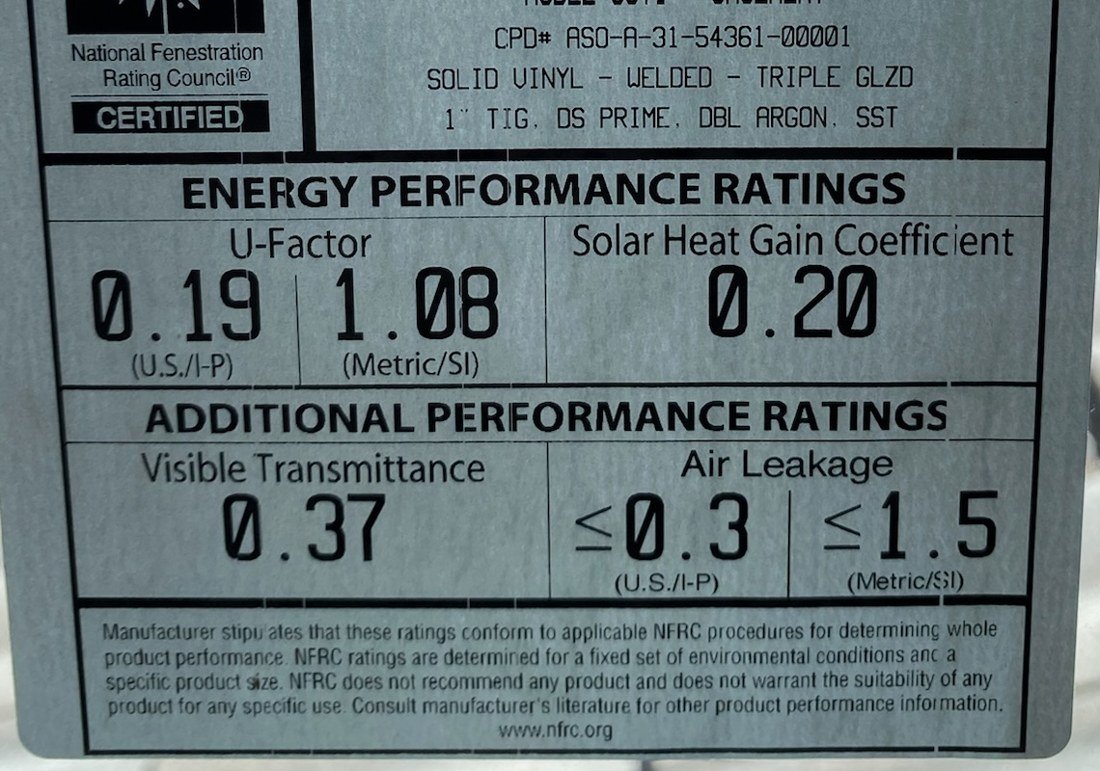
Adam shared this NFRC label from an Insignia triple-pane casement window. The description line reads “Triple GLZD” (triple glazed) and “Dbl Argon” (two argon-filled spaces). Why does it say Alside? Insignia windows are made by Alside. So an Insignia window’s label shows the Alside name and model number. Here is what the numbers mean for a Colorado home.
U-factor 0.19: beats ENERGY STAR’s 0.22 Northern zone requirement and its 0.20 Most Efficient U-factor target.
SHGC 0.20: above the 0.17 minimum, so winter sun still helps heat the room.
Visible transmittance 0.37: the trade-off for three panes and coatings. Rooms get a little less daylight than with clear double-pane glass.
Air leakage 0.3 or less: meets most building codes.
Condensation resistance: not listed on this label. That’s normal, since it’s optional.
One more detail: the label lists the window size it was tested at. Ratings are measured at a fixed size, so the same model in a different size will rate a little differently.
A quick checklist for Colorado
U-factor of 0.22 or lower
SHGC of at least 0.17, with lower-SHGC glass only where summer sun is a problem
Air leakage of 0.3 or less
Label numbers for the exact window in your quote
Altitude-rated glass if your home sits above 6,000 feet
Want to see a real label?
Adam will walk you through the NFRC label on the Insignia window in your quote, number by number. Call 720-954-8110 or book a free 15-minute call.